Harmonica (Part 3) - Harry Pitch

No not Harry Patch

The third of out three is the least well known by name, without even a Wikipedia page, but his music continues to endure long after his passing, and in terms of British popular culture his contribution was outstanding. His name was Harry Pitch.

In his obituary it stated “Harry was one of the handful of players who have turned harmonica playing into an art form. A player of enormous fluency and invention, his career has spanned six decades and innumerable gigs and sessions. He was one of Larry Adler´s favourite players.”

Harmonica (Part 2) - Larry Adler

Turning to Adler, whereas Geldray’s musical career was largely European, and Pitch’s British, Adler’s was largely American.. In his lifetime, too, he knew and worked with or for some of the greats of the music business.

Harmonica (Part 1). Max Geldray.

The Harmonica, sometimes called the mouth organ, is an instrument with a unique sound. While it is not mainstream, some harmonica tunes have become iconic in their own right, such as the Ennio Morricone’s harmonica track in “Once a Time in the West” or in Britain, the theme tune of “Last of the Summer Wine”.

Arguments rage over the ‘best’ harmonica players of all time; from obscure but gifted specialist blues/jazz players to those who have made the most famous use of the instrument such as Bob Dylan,  Stevie Wonder and John Lennon. Of the latter three musicians stood out in the British public consciousness…… and were Jewish. They were Max Geldray, Larry Adler, and Harry Pitch, a Dutchman, an American, and a Brit.

To avoid them becoming part of the Forgotten History of the Jews, we need to refresh our memories and remind ourselves of the impact that they made in Britain during their careers, so here they are……

1933

It was 1933 that the Jewish World changed forever. It was also 1933 that a book called “The Friday Night Book” the subtitle being “A Jewish Miscellany” was published by the Soncino Press in 1933. There was no identified writer. A few copies survive, one being a Prize for Maurice Blank (my father-in-law for 2nd place at his Cheder in 1938. Here and there flashes of the Jewish World in 1933 come to the fore, and there is a certain innocence about the book.

Here are some extracts. I have also commented some of the entries The saddest one is the first one, for ten years later things would have changed forever.

German Dance/Jazz Bands

Introduction

After World War 1 Germany suffered from hyperinflation, political extremism and food shortages, with the economy having tanked.

 However, there was a recovery of the German economy from 1924 to 1929, which became known as the “Golden Age”, and there was a flowering of arts and culture in the German Republic, especially in the cities.

 Why only the cities? Despite this recovery two thirds of the German population was still rural and insular. The folk culture of the German nation was still largely alive and kicking, and with it, innate conservatism.

Archer Street


In my book I have explained how the sons of immigrants became some of the best known bandleaders in the Golden Age of Dance Bands.

 Growing up in tight knit communities, those who took up a musical instrument would have had the opportunity laid out in front of them to form small bands with their co-religionists, and even earn good money accompanying silent films at their local cinema. It is likely that their contacts within the communities would have helped them make their first steps beyond the environs of Bethnal Green and similar ‘shtetls’.

 For those living in London, especially East London, there was a further route that many could go down. Ronnie Scott (Ronald Schatt) said that Jews who wanted to play music travelled from the East End to the West End, and for many of them, Jew and non-Jew the place they gravitated to was Archer Street.

The Time of My LIfe (Eamonn Andrews)

Introduction

From my book Kosher Foxtrot

I was giving old Punch magazines a scan before throwing them into the paper waste, when I came across this article written by Eamonn Andrews in April 1975.

He was a well-loved TV presenter, sports commentator, and an A-List celebrity from the 1950s - 1980s who pioneered the talk show host format in the UK, and was noted for two shows: What’s My Line, and This is Your Life, a British biographical show, both of which had top rating.

It is a snapshot of an era, of his life and of dance bands on the road. For those who remember Jewish Restaurants as they used to be, it has an extra thrill. So, as they say, over to Eamonn:

Featured Story

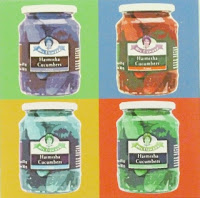
Mrs Elswood pickles exceedingly good cucumbers

When Premium Foods, who bought the Mr Kipling brand when they acquired Rank Hovis McDougall, they kept the phrase “Mr Kipling bakes exceedin...